
Step by step and go slow, give every step the time to sink in and find its place within you and within the horse. The first step is to show the horse that we are looking for a connection. If horses want to be friends with another horse, they approach each other calmly, probingly and respectfully. They remain still at the edge of the personal space of the other horse. By mirroring the behavior of the other horse, the first horse communicates that it’s open to cooperation and connection. When the other horse answers back by checking some slow friendly movements, it means “yes, we can be friends”. When we, as humans, suddenly start mirroring a horse, our horse may have to get used to it in the beginning. But because it is a familiar way of communication to the horse, they will pick it up quickly and gratefully. All of a the sudden they will get it “oh, you mean you want to be my buddy! Now isn’t that cool.”
What exactly does this mirroring look like? With mirroring we try to synchronize movements with the horse as evenly as possible, for example looking away at the same time and looking back again or breathing out a sigh at the exact same time. You will notice that horses pick up on this mirroring right away and will respond openly and positively. What will synchronizing with a horse bring us? For us the lesson will be to experience the energy of the horse and how it feels in our body. What does it feel like to be relaxed with each other. How does that energy feel within you, how do the movements feel, what does balance feel like? These are very important lessons. And you can’t do this often enough, you want it to be your second nature. I approach my horse in this manner every time I work with the animal. I show the horse that nothing has changed, everything is the same, it’s still all good between us. As a result, the horse does not have to guess about our connection and does not have to check me whether things have changed since the last time it saw me.
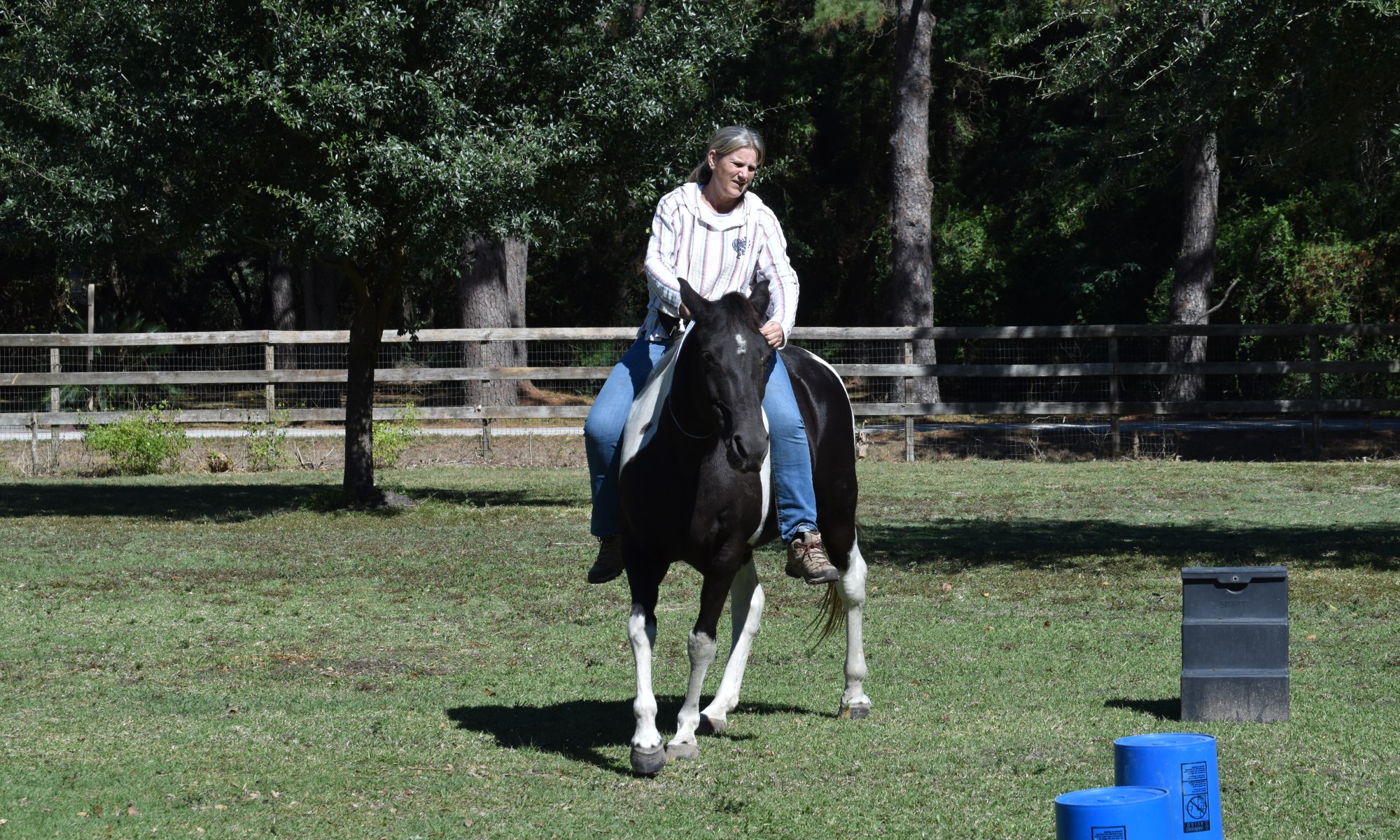
When contact has been made, you can start with simple exercises. I put two cones (buckets will work as well) next to each other that will be the start and end point of the exercise. I literally ask the horse questions in my head. When I approach the two cones with the horse I think “oh, look cones, how do you (the horse) feel about this?” And the behavior that the horse shows is the answer. Be aware of the fact that you and what you do is a big part of the big picture. When a horse is afraid of the cones and doesn’t want to approach them, your presence is an important part within that picture. So it’s not about the horse that needs to learn that cones aren’t scary. It is a situation where we help the horse realize that you as a human have something to offer the horse when the horse is scared. For a confused horse,a human present in the situation, that that means the situations might get worse and the horse has to prepare itself for flight.
Impress your horse.
So let’s assume we approach the two cones and your horse reacts with fear and does not want to go with you. Something happens in the horse’s body. Perhaps it stands still and refuses to move forward. Even if the horse only gives the cones the side eye, it still means the horse isn’t sure. Maybe it’s moving to the left and right and can’t stand still? Is the horse breathing faster? That’s valuable information. If, in this moment, you take your eyes away from the cones, to look at what your horse is doing and allow your gaze to rest upon the horse’s face. The chances are that the horse will think that you are not sure about these cones as well and that you are asking the horse to take the lead in this situation. Right there you made the promise to the horse that anything it chooses to do, you will follow its lead. This can make the situation more unsafe for a horse. You had a plan, you walked towards the cones, you stepped away from your plan and asked the horse to lead while the horse is feeling insecure about the situation. So don’t be surprised when the horse is even more hesitant to approach those monster cones. And some horses might even answer with a “I’m outta here!!!”
And imagine that a horse notices that you step away from your goal on a regular base and let your eyes rest on your horse. To the horse this is very clear communication, you are systematically depending on the horse’s lead and will follow. Imagine the confusion of the horse when it deciseded to run away, but you are not following at all? Instead you are trying to control the animal. And another consequence, when you, from the horses perspective, communicate systematically that you need the horse to lead. The horse is not going to check in with you when it needs guidance. You made very clear that you do not have the answers in you. Or, for example, you look your horse in the face and wait for it to take a step forward towards the cone and you use a clicker to reward that step forward. That can make the horse confident but it will also systematically teach the horse that there’s no need to check in with you. You missed the chance to connect. And that’s how seemingly small gestures can cause ambiguity and get in the way of the connection.
The moment you stay focused on your goal and your goal is to approach the cones together. By using your body language, being relaxed and use slow deep breathing, it will show your horse that you are not scared. When you notice that the horse reacts anxiously, you can position yourself in between the cones and the horse. This shows the horse that you notice that the horse is uncertain about the situation, and that you will protect the horse. It will be clear to the horse, in times of danger those cones will eat you first and the horse will then have plenty of time to run away. This gesture really impresses horses, they use ‘blocking’ within communication on a regular base. Next step could be, try to take your gaze away from the cones and look at something else while letting out a sigh. By doing that you are saying, “oh it might have been a little scary, but I notice now that all is fine” But remember, you really have to feel and believe this, the movement without matching energy will not work as effectively. And with sensitive horses, when you don’t believe and only go through the motions, it will not work at all.
Your action can work as an incentive for a horse to get brave and investigate the cones. Or you yourself can step up and check out the cones, for example by touching them with your foot. When the horse follows your lead and approaches the cones, that is a good time to reward the horse. All of this is not about whether we immediately get the horse to stand still in between the two cones, it’s about learning who this horse is, how does it deal with situations, how it feels about the relationship within the situation and how you can guide the horse without causing confusion. The next time you approach the two cones, notice anything that has changed in your horse. It is all information.
Next time I’ll share more on this subject.
 Tadita Orenda